Feature story

The monitoring publication uses 24 specific indicators—including land ownership patterns, water availability, and food security levels—to assess environmental situations across different regions. Nearly 50 faith leaders and development practitioners from around the world gathered online for a recent international webinar to explore its applications. The European Christian Organisations for Relief and Development organized the event with the International Partnership for Religion and Sustainable Development, a global partnership promoting collaboration between religious and secular organizations on sustainable development. The session highlighted how religious communities now use data-driven approaches to understand and respond to environmental challenges.
"We are basically trying to collect the data from reputable secondary data that is available in public domain related to land water and food issues and present the data together in one publication," said Dinesh Suna, WCC programme executive for Land, Water, and Food, coordinator of the WCC Ecumenical Water Network, and editor of the Living Planet Monitor.
The Living Planet Monitor launched its first edition on Southern and Eastern Africa. It gives faith communities and policymakers consolidated information that combines statistical analysis with stories of community resilience. The publication includes detailed case studies from Kenya, Zimbabwe, and Ethiopia, showing how local churches and faith-based organizations tackle food security, renewable energy, and environmental restoration.
Suna stressed the collaborative vision: "Our aim is that you all become our eyes and ears of the monitor to monitor the planet, so that it is living and thriving."
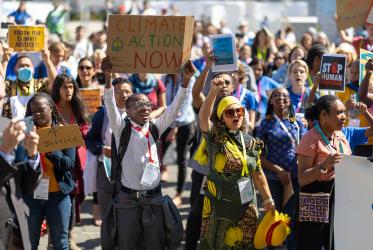
The webinar also introduced the newly approved Ecumenical Decade of Climate Justice Action (2025-2034), presented by Athena Peralta, director of the WCC Commission on Climate Justice and Sustainable Development. The decade-long initiative creates six pathways for faith community engagement, from transforming theology to investing in grassroots solutions.
"This is meant to be coordinated and joint response by churches," Peralta said. "This is not meant to be simply a campaign or a project. This is also very much about a spiritual journey of spiritual transformation."
Interactive discussions followed the presentations. Participants split into breakout groups to discuss practical applications of the Living Planet Monitor findings. They also developed concrete commitments for local action. The European Christian Organisations for Relief and Development, representing Europe's largest Christian organizational network, and the International Partnership for Religion and Sustainable Development members used the session to identify opportunities for expanding the publication's reach.
Looking ahead, Maike Gorsboth is taking over as managing editor for future editions. She outlined plans for the next publication on the Asian region, expected in early 2026. "The really exciting challenge here is to make sure that we connect the indicators and the statistics that we gather, meaningfully with the insights and the stories behind those numbers," Gorsboth said. "Because in the end I think that's what inspires action."
The Living Planet Monitor combines statistical analysis with community stories. It has gained recognition from multilateral organizations, UN bodies, and civil society networks. The publication draws from over 280 sources. These are brought together in one resource for faith communities exploring environmental challenges and community responses.
This partnership between the European Christian Organisations for Relief and Development and the International Partnership for Religion and Sustainable Development shows growing momentum among international faith networks. Both organizations now work to integrate the Living Planet Monitor into their educational and advocacy programs. They reach hundreds of member organizations across multiple continents.
The initiative connects directly with the WCC's broader climate justice work. "We envision first of all, churches leading by example," Peralta noted. She explained how the decade aims to transform how faith communities engage with environmental challenges through both spiritual transformation and practical action.
Download the Living Planet Monitor, Volume 1 here
Seminar focuses on global decade of climate justice (Video feature, 02 September 2025)